No products in the cart.

SEO for physical therapists is the work of making a clinic easy to find, easy to trust, and easy to contact. Patients often search by symptom, injury, treatment, or location before they know which clinic they want. The clinic’s website needs to meet that search with a useful answer and a clear next step.
That does not require publishing a new article every week. For most clinics, the better starting point is one high-value service page, an accurate Google Business Profile, and a booking path that works on a phone. Build from there based on the services and patients the clinic actually wants to attract.
Start with how patients choose a clinic

Most prospective patients do not begin with a clinic name. They search for a symptom, diagnosis, treatment, or nearby provider, then use the results to decide which clinics seem relevant and credible.
A clinic may need to be visible for searches such as “physical therapist near me”, “physical therapy for knee pain”, “sports rehabilitation in Overland Park”, “pelvic floor physical therapy”, “physical therapy after shoulder surgery”, and “can physical therapy help with sciatica”.
These searches represent different levels of intent. “What causes knee pain” is an information search. “Knee pain physical therapy near me” is much closer to an appointment decision.
| Search type | What the patient wants | Best page or asset |
|---|---|---|
| Service | To understand a treatment the clinic offers | Service page |
| Condition | To know if the clinic treats a specific problem | Condition page |
| Local provider | To compare nearby clinics | Google Business Profile and location page |
| Question | To understand symptoms or the care process | Helpful article or FAQ |
| Branded search | To confirm details about a clinic they already know | Homepage, contact page, and profile |
The point is not to create a page for every phrase. Choose the services, conditions, and locations that matter to the clinic, then make those pages useful enough that a prospective patient can decide what to do next. A page that simply repeats a keyword without explaining the care experience will not do much for the practice.
Build pages that can do real work

A clinic website should give each important patient need a clear path to care. If every treatment is placed on one generic services page, a visitor has to figure out which part applies to them, and the clinic loses the opportunity to explain its strongest services in detail.
Start with the pages closest to revenue: a primary physical therapy services page, individual pages for important specialties, condition pages for problems the clinic treats often, useful location pages for real service areas, clinician biographies, and a contact or scheduling page. The point is not to build the biggest site. It is to give each important patient need a clear place to land.
Each page needs a distinct job. A dry needling page should explain who may benefit, what a visit involves, how it fits into a broader treatment plan, and what the patient should do next. It should not be a lightly rewritten copy of the main services page.
Improve the pages you already have
New pages are not automatically progress. If an existing page already receives visits or links, improve it before creating a larger site structure.
The page should answer the questions a new patient is likely to have: what problem the clinic treats, who provides the care, what happens at the first visit, whether a referral is required, whether the clinic accepts the patient’s insurance, and how to schedule.
A page can attract a searcher and still lose the appointment because it is vague, difficult to scan, or missing the next step. SEO work should make the page more useful, not simply longer.
Local SEO is how a clinic becomes the nearby option

Physical therapy is usually chosen within a practical driving distance. Local SEO therefore deserves the same attention as the website’s service pages.
The clinic’s Google Business Profile should match the website on its name, address, phone number, hours, services, and appointment link. The profile should represent the real clinic, not a list of locations the business does not operate.
Reviews help patients evaluate whether a clinic seems trustworthy. Ask for honest feedback through a consistent process, respond professionally, and never write reviews for patients or offer incentives for favorable reviews.
A location page can answer practical questions the Google Business Profile cannot, such as where patients should park, whether the building is accessible, which nearby communities the clinic commonly serves, what a first-time visitor should expect, and whether the clinic is accepting new patients.
Do not create nearly identical pages for every town nearby. If the clinic has one office, one detailed local page is often more useful than a group of thin pages with city names swapped in. A local page should help someone decide to visit the clinic, not merely prove that the clinic has heard of the city.
Create content that supports an appointment decision
Blog content is useful when it connects a patient question to a service the clinic actually provides. It is less useful when it exists only to increase the number of URLs on the site.
Good topics tend to sit along the patient journey:
| Patient question | Useful article angle | Next page to link |
|---|---|---|
| Should I see a physical therapist for back pain? | Explain common reasons to seek an evaluation and when urgent care may be appropriate | Back pain service or condition page |
| What happens during a physical therapy evaluation? | Describe the visit, movement assessment, and treatment planning | New patient or scheduling page |
| Can physical therapy help after surgery? | Explain how rehabilitation may fit into recovery without promising a result | Post-surgical rehabilitation page |
| Why does my running injury keep returning? | Discuss training load, movement, recovery, and individualized assessment | Sports rehabilitation page |
The article should answer the question early. Then it can add context, explain limits, and point the reader toward a relevant next step.
Because this is health content, the clinic should avoid diagnosing readers, guaranteeing outcomes, or presenting one treatment as appropriate for everyone. A physical therapist can explain common patterns while still making clear that an evaluation is needed for individualized advice.
Make the website earn the click
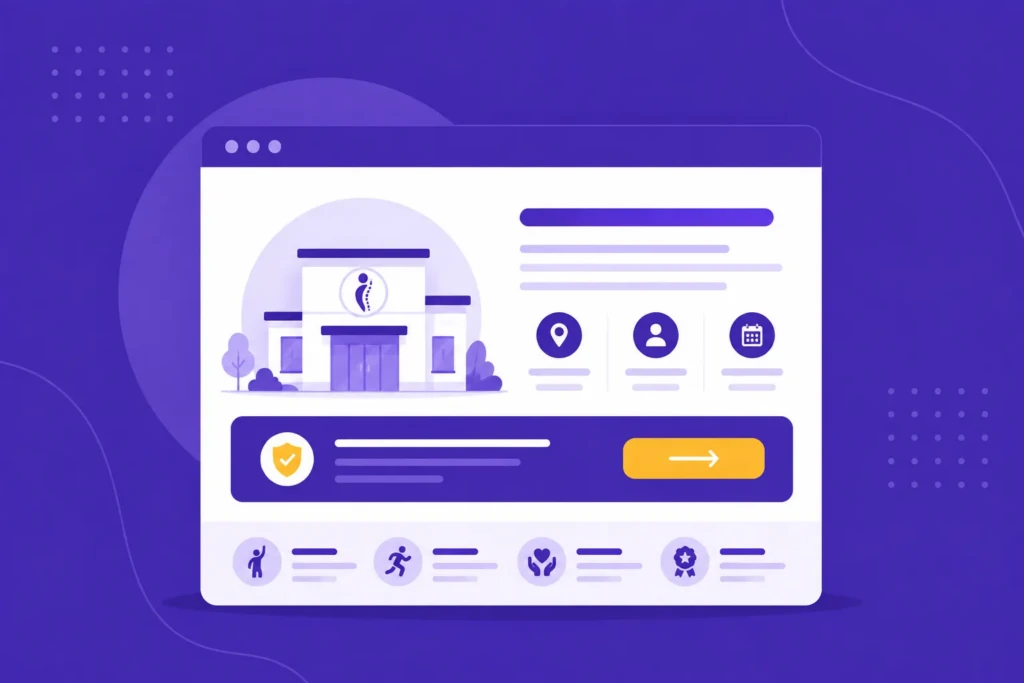
Search visibility is only valuable if visitors can understand the clinic and act. A good service page does not force someone to hunt through the navigation for a phone number or scheduling link.
On mobile and desktop, make the clinic’s phone number, direct scheduling action, address, office hours, referral requirements, insurance information, first-visit expectations, and a short explanation of who the service is for easy to find. These details should not be scattered across several pages.
The call to action should fit the clinic’s real process. If patients must call before booking, say “Call to schedule an evaluation”. If online scheduling is available, link directly to it. Do not label a button “Get started” when the patient actually needs to complete a form or call an office.
Trust comes from specifics, not decorative badges
Patients want to know who will treat them and what the experience will be like. Clinician biographies should describe relevant training and areas of practice in plain language. Photos of the clinic can reduce uncertainty for a first-time visitor.
Include information that affects the decision, including current insurance details, referral and evaluation requirements, accessibility and parking information, relevant credentials, professional memberships, real patient reviews shown through an appropriate system, and a clear privacy notice for contact forms.
A page covered in awards and icons is not necessarily more credible. Specific information is usually more reassuring than decoration.
Common SEO mistakes that waste time

The mistakes that cost a clinic the most are usually strategic rather than technical. They lead to pages that attract the wrong visitors, create unnecessary work, or make interested patients hesitate.
Creating pages for every nearby city
This produces repetitive content and gives visitors little reason to trust the page. Build a location page only when the clinic genuinely serves that area and can add useful information about the visit. Otherwise, strengthen the primary location page instead.
Putting every service on one page
A general list does not adequately answer a patient searching for pelvic floor therapy, post-operative care, or sports rehabilitation. Give priority services their own pages when the clinic can explain them in depth.
Publishing articles with no path to care
An article may receive traffic but contribute little to the practice if it never connects the reader to a relevant service or explains what to do next. Before publishing, identify the one appointment decision the article should support, then link and write toward that decision.
Treating rankings as the only success measure
A ranking report cannot tell you whether calls are answered, forms work, or visitors understand the offer. Track appointment requests, phone calls, form submissions, and the pages those visitors used.
Making claims the clinic cannot support
Avoid guarantees such as “permanent relief” or “cure your pain”. Use careful language about potential benefits and make room for individual differences in evaluation and treatment.
What to fix first
A clinic does not need a complete redesign to make meaningful SEO progress. The right first project depends on what is currently failing.
| If the clinic has this problem | Start here | Do not start here |
|---|---|---|
| Wrong hours, phone number, or address online | Correct the Google Business Profile and website details | Publishing another blog post |
| Visitors reach service pages but do not inquire | Rewrite the page, clarify the offer, and test the call to action | Creating more thin service pages |
| The clinic has one generic services page | Separate the highest-priority services and conditions | Building pages for every possible keyword |
| Good traffic but few appointment requests | Test forms, phone tracking, scheduling, and mobile usability | Assuming the issue is only rankings |
| Little local visibility | Improve the profile, reviews process, location information, and local page | Buying a large batch of low-quality links |
This order matters. More traffic will not solve a confusing service page, a broken form, or an unanswered phone. Fix the path from search result to appointment before investing heavily in additional content.
Putting this into practice
Choose one service or patient problem that matters to the clinic’s schedule and revenue. Review the corresponding page as if you were a new patient who has never heard of the clinic. Can you tell what the clinic treats, who provides the care, what the first visit involves, and how to schedule without searching through the rest of the site?
Then check the Google Business Profile and complete a real test of the phone, form, or scheduling path. Once that first path works, use the same process for the next priority. A focused sequence of useful pages and working appointment paths is more sustainable than a large content project with no clear connection to patient care.
What this looks like in practice: Calibration Physical Therapy
These recommendations are based on work I have done, not just general SEO theory. For Calibration Physical Therapy, I worked on the site migration, technical foundation, service pages, local SEO, analytics, and educational content. In the first three-month performance report, users increased 55%, sessions increased 49%, and engaged sessions increased 26%.
Search Console also showed clicks increasing from 560 to 964, impressions increasing from 89.5K to 216K, and average position improving from 23.2 to 10.6. Local visibility moved in the same direction, with Google Business Profile views up 57% and interactions up 80%. Those numbers describe measured visibility and engagement during a defined reporting period. They are not a guarantee that every clinic will see the same result, but they show the kind of progress a focused SEO process can produce.
The Calibration Physical Therapy case study includes the latest available updates, screenshots, and performance context. It is the best place to review how the work developed over time.
Work With TCB Studio

TCB Studio helps physical therapy clinics improve the parts of their websites that affect visibility and patient inquiries. That can include service-page structure, local SEO, WordPress improvements, conversion-focused copy, and technical cleanup.
The work starts with the clinic’s actual priorities: the services it wants to grow, the patients it serves, and the points where the current website makes people hesitate. That keeps the project focused on useful improvements instead of adding content for its own sake. Browse our services to get started.