No products in the cart.
Astro is a modern web development framework designed to build fast websites with minimal JavaScript. It generates most pages as static HTML and only loads JavaScript for interactive components.
For creators, small businesses, and independent developers, Astro has become popular because it makes it easier to build websites that load quickly, scale well, and integrate with modern tools. In this article, we will explain what Astro is, how it works, why developers use it, and when it makes sense to choose it for your website.
What Is Astro?
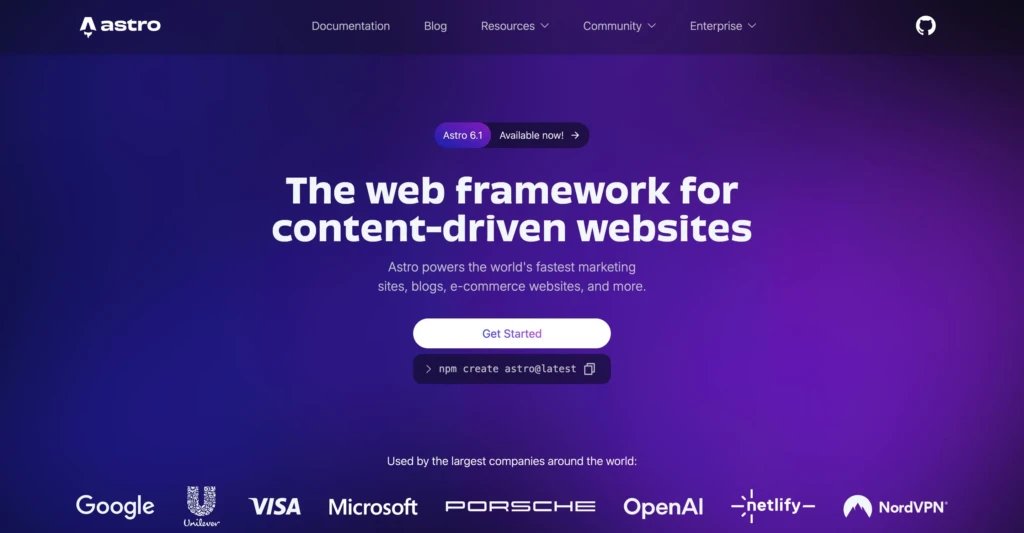
Astro is a modern web framework designed to build fast, content-focused websites by sending very little JavaScript to the browser.
Instead of turning an entire site into a large JavaScript application, Astro generates static HTML during the build process and only loads JavaScript for interactive components when necessary.
This approach makes Astro particularly well-suited for websites where most of the content is informational rather than interactive.
Examples include:
- Blogs
- Marketing Websites
- Documentation Sites
- Knowledge Bases
- Small Business Websites
Many modern frameworks prioritize building complex web applications. Astro was created to solve a different problem. It focuses on delivering fast, content-heavy websites without the performance cost of unnecessary JavaScript.
For developers, that means better performance and simpler architecture. For visitors, it means faster page loads and a smoother browsing experience.
How Astro Works
Astro builds websites by generating static HTML during the build process rather than assembling pages entirely in the browser.
In traditional JavaScript-heavy frameworks, the browser downloads a large JavaScript bundle and runs it to render the page. This can slow down the initial page load, especially on mobile devices.
Astro flips that model. Instead of asking the browser to build the page, Astro generates the page ahead of time and delivers ready-to-render HTML to the user.
A typical Astro workflow looks like this:
- Content is written in Astro files, Markdown, or MDX.
- Layouts and components are assembled using Astro’s templating system.
- Developers can include components from frameworks such as React, Vue, or Svelte when needed.
- Astro compiles everything during the build process and produces static HTML pages.
- Only interactive components ship JavaScript to the browser.
The result is faster page loads, lower JavaScript overhead, and better performance across a wide range of devices.
The Islands Architecture
One of Astro’s core ideas is something called Islands architecture.
Instead of treating the entire page as a single JavaScript application, Astro breaks it into small, interactive regions called islands. A simplified version of this architecture looks like this:
Static HTML Page
 ├─ Content
 ├─ Images
 ├─ Navigation
 └─ Interactive Islands
      ├ Search bar
      ├ Form
      └ Widget
Most of the page remains static HTML. Only the pieces that require interaction load JavaScript.
For example, imagine a typical marketing page.
The majority of the page might contain:
- Text Content
- Images
- Headings
- Navigation
These elements do not require JavaScript to function. They can be delivered as simple HTML.
However, the page might also contain a few interactive features:
- Search Box
- Contact Form
- Scheduling Widget
- Interactive Calculator
In Astro, those interactive pieces become isolated islands of JavaScript inside an otherwise static page.
Because only a small portion of the page runs JavaScript, the browser has far less code to load and execute. This significantly improves page speed and reduces performance issues.
Why Developers Are Using Astro

Astro has grown quickly in popularity because it solves a real problem in modern web development.
Many frameworks today are extremely powerful, but they often introduce unnecessary complexity for content-driven websites.
Astro focuses on a different goal. It prioritizes performance, simplicity, and flexibility for sites where content is the main focus.
Several characteristics make Astro attractive to developers:
Performance
Astro ships significantly less JavaScript to the browser than most modern frameworks.
Because pages are generated ahead of time and delivered as HTML, visitors can see content almost immediately. This reduces the delay between opening a page and being able to read it.
Performance improvements are especially noticeable on mobile devices or slower network connections.
Framework flexibility
Astro allows developers to use components from multiple front-end frameworks in the same project.
For example, a site could include:
- React Search Component
- Vue Interactive Widget
- Svelte Animation
- Static HTML Layouts
Astro coordinates these pieces while ensuring only the required JavaScript is delivered to the browser.
This flexibility makes it easier to integrate existing tools or reuse components across projects.
Content-first architecture
Astro is built for content-heavy websites.
Developers can easily create pages using Markdown, MDX, or structured content collections. This makes Astro particularly useful for projects like documentation platforms, blogs, and educational websites, where the majority of the site consists of written content.
For many developers, Astro represents a balance between the performance of static site generators and the flexibility of modern JavaScript frameworks.
Astro vs Traditional JavaScript Frameworks
To better understand Astro, it helps to compare it with more traditional frameworks.
| Feature | Astro | React / SPA frameworks |
|---|---|---|
| Rendering approach | Static-first | Client-side heavy |
| JavaScript usage | Minimal by default | Often large bundles |
| Performance | Typically faster | Depends on optimization |
| SEO friendliness | Excellent by default | Can require extra setup |
| Ideal use cases | Content websites | Web applications |
Traditional frameworks like React are powerful tools for building complex applications such as dashboards, software interfaces, and highly interactive products.
Astro focuses on a different type of problem.
It excels when most of the website is content, with only small parts requiring interaction.
When Astro Makes Sense
Astro is particularly useful for projects where performance and content delivery are priorities.
Common examples include:
- Blogs
- Marketing Websites
- Documentation Platforms
- Creator Portfolios
- Small Business Websites
- SEO Content Hubs
For example:
A consultant building a website with articles, guides, and service pages might benefit from Astro because it generates extremely fast pages that perform well in search results.
Similarly, a creator running a documentation site or digital product resource library could use Astro to keep pages lightweight and fast.
When Astro Might Not Be Ideal
Astro is not designed for every type of project.
Some websites are better suited to other frameworks.
Examples include:
- Complex Dashboards
- Large Interactive Web Applications
- Software Platforms With Heavy Real-Time Interaction
- Highly Dynamic User Interfaces
In those situations, alternative frameworks like React, Next.js, or Vue may provide a better foundation.
Astro can still integrate those frameworks for components, but its primary strength lies in content-first sites rather than application-heavy products.
Astro and Content Management Systems
One reason Astro has gained popularity is its integration with content systems. Developers can use several approaches for managing content in Astro projects.
Markdown-based content
Astro supports Markdown and MDX by default. This makes it easy to build blogs and documentation websites.
Headless CMS integration
Astro can connect to external content management systems through APIs, significantly extending its functionality.
Examples include:
Local content collections
Astro also supports structured content stored directly in the project.
This allows developers to organize content like:
- Blog Posts
- Documentation Pages
- Tutorials
- Resource Libraries
This approach works well for small teams or solo creators who want more control over their content system.
Astro and SEO Performance

Website performance plays a major role in search visibility, and Astro’s architecture supports many technical SEO best practices.
Because Astro generates HTML during the build process, search engines receive a fully rendered page immediately when they crawl the site. This avoids many of the indexing challenges that occur with heavy client-side rendering.
Astro also improves several technical performance factors that influence search rankings.
Fast page load times
Pages generated by Astro typically load very quickly because the browser does not need to download large JavaScript bundles before displaying content.
Improved CWV
Astro pages tend to perform well with performance and mobile responsiveness, which are important for Google’s Core Web Vitals:
- Largest Contentful Paint (LCP): Measures loading performance.
- Interaction to Next Paint (INP): Measures responsiveness.
- Cumulative Layout Shift (CLS): Measures visual stability.
These measurements indicate the key areas Google cares about for website performance, and Astro projects can score well and deliver excellent results.
Clean HTML structure
Because Astro generates static markup, the resulting HTML tends to be simpler and easier for search engines to interpret.
For websites that rely on organic traffic, these performance advantages can significantly improve visibility and user engagement.
Astro vs Next.js and Modern Frameworks
Astro is often compared to frameworks such as Next.js because both are used to build modern websites. While they share some similarities, they focus on different types of projects.
Here is an overview of the differences between Astro and Next.js:
| Feature | Astro | Next.js |
|---|---|---|
| Primary focus | Content websites | Web applications |
| JavaScript usage | Minimal by default | Often heavier |
| Rendering model | Static-first | Hybrid rendering |
| Best for | Blogs, marketing sites | SaaS apps, dashboards |
Next.js is extremely powerful for building full web applications. It provides tools for authentication systems, API routes, and dynamic data handling.
Astro takes a more focused approach. It excels when most of the site consists of content, with only small portions requiring interactivity.
For many projects, especially blogs or marketing websites, Astro can deliver faster performance with a simpler architecture than Next.js.
How Developers Use Astro in Real Projects
Astro is commonly used to build performance-focused websites where content plays a pivotal role.
In practice, developers often use Astro for projects such as documentation hubs, marketing sites, and content platforms.
For example, a SaaS company might build its marketing website using Astro while the product itself runs on a separate framework.
Similarly, many creators and developers use Astro to power:
- Blogs
- Technical Documentation
- Digital Product Websites
- Resource Libraries
- Portfolio Sites
Because Astro allows developers to mix multiple front-end frameworks, it is also useful when only small portions of a site require advanced interactivity.
For instance, a website could use mostly static HTML pages while embedding a few interactive components, such as:
- Search Interface
- Pricing Calculator
- Product Preview
This hybrid approach allows teams to maintain fast page performance while still supporting modern web features.
Astro vs Static Site Generators
Astro is sometimes compared to older static site generators such as Jekyll or Hugo. While they share some similarities, Astro is more flexible in several ways.
| Feature | Astro | Traditional Static Generators |
|---|---|---|
| Framework components | Yes | Usually no |
| Partial interactivity | Yes | Limited |
| Multi-framework support | Yes | No |
| Modern build tooling | Yes | Varies |
Astro combines the speed of static sites with the flexibility of modern JavaScript frameworks. This hybrid approach is part of what has made it popular among developers building modern content platforms.
What Astro Means for Small Businesses
Small businesses often struggle with slow websites that were built with tools designed for larger applications. For example, some website builders or poorly configured frameworks load large JavaScript bundles even for simple pages.
Astro offers an alternative. Instead of relying on large JavaScript frameworks for simple websites, Astro delivers most pages as static HTML while still allowing interactive features when needed.
A content-driven business site built with Astro can achieve:
- Faster Page Loading
- Better Mobile Performance
- Improved Search Visibility
- Cleaner Technical Foundation
For businesses that rely on organic traffic, performance improvements can have a real impact.
Project Example: A Small Business Website
To see where Astro fits, it helps to think about a typical small business website. Most small business sites contain a mixture of informational pages and a few interactive tools.
For example, a site might include:
- Home Page
- Service Pages
- Blog Posts Or Guides
- Contact Form
- Appointment Booking Widget
The majority of these pages are informational content. Visitors simply need to read the page, view images, and navigate between sections. Only a few features actually require interactivity.
With Astro, the informational parts of the site can be delivered as static HTML while the interactive elements load JavaScript only when necessary. This approach keeps the site lightweight while still supporting features like scheduling tools, search boxes, and interactive forms.
For small businesses that rely on fast websites and organic search traffic, this balance can be extremely valuable.
Who Should Use Astro?
Astro is a good fit for developers and teams building content-focused websites where performance matters.
It is particularly useful for:
- Technical Documentation Sites
- Blogs And Publishing Platforms
- Marketing Websites
- Knowledge Bases
- Small Business Websites
- Digital Product Websites
In these types of projects, most pages are informational rather than highly interactive. Astro allows developers to deliver fast pages while still supporting interactive components when needed.
For projects that behave more like software applications than websites, frameworks such as React or Next.js may be a better fit.
Getting Started With Astro

For developers interested in trying Astro, the basic setup process is straightforward.
The typical workflow includes:
- Installing Astro using Node.js
- Creating a new Astro project
- Building pages using Astro components or Markdown
- Adding interactive components when needed
- Deploying the site to a hosting platform
Astro works well with many hosting providers, including:
- Cloudflare Pages (Recommended)
- GitHub Pages
- Netlify
- Vercel
These platforms can automatically build and deploy Astro sites when new content is published.
Applying This to Your Business
Understanding tools like Astro helps business owners and creators make smarter decisions about how their websites are built.
Fast websites improve user experience, search visibility, and overall performance. For content-driven businesses, the underlying framework can significantly impact how well a site scales over time.
At TCB Studio, I help small businesses and creators choose the right technical foundation for their websites, whether that means WordPress, Astro, or another framework.
If you are evaluating website platforms or planning a new project, the technical foundation you choose matters. Astro is one of the frameworks worth understanding when performance and content delivery are priorities.