No products in the cart.

Most websites, web applications, and online tools succeed or fail based on what users actually experience on the screen. Visitors do not see databases, servers, or APIs. They see pages, buttons, forms, navigation menus, product listings, and content.
Front-end development is responsible for creating that experience. It determines how a website looks, behaves, and responds when someone interacts with it. Understanding how front-end development works can help business owners make better decisions about website performance, usability, SEO, and long-term maintenance.
What Is Front-End Development?
Front-end development is the practice of building everything a visitor sees and interacts with on a website or web application.
It includes the layout, navigation, buttons, forms, images, menus, animations, and other visual elements that appear in a user’s browser. Front-end developers take designs, content, and functionality and turn them into a working interface that people can actually use.
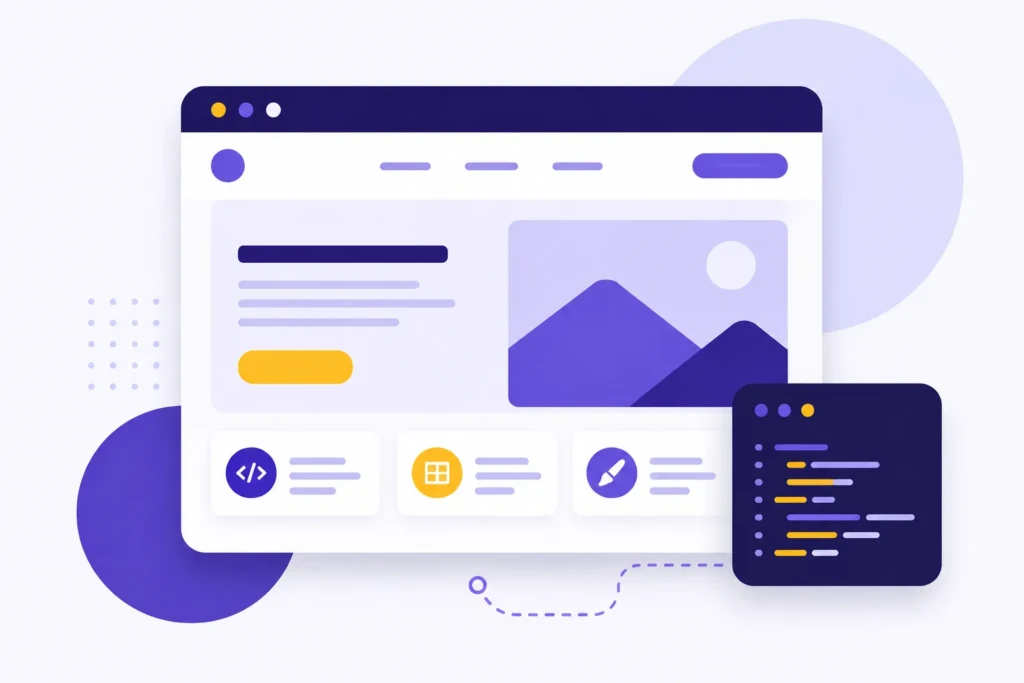
When someone visits a website, the front end is responsible for nearly every part of their experience. It determines how quickly pages load, how easy navigation feels, how well the site works on mobile devices, and how smoothly visitors can complete actions such as making a purchase, filling out a form, or finding information.
Front-end development sits between design and back-end development. Designers focus on how a website should look and feel. Back-end developers build the systems that power features behind the scenes. Front-end developers connect those pieces together and create the experience users interact with every day.
For businesses, front-end development is not just about appearance. A well-built front end can improve usability, conversion rates, search performance, and customer trust. A poorly built one can create friction that drives visitors away, regardless of how good the product or service may be.
How Front-End Development Works
Every front-end project is built on a foundation of three core technologies.
| Technology | Purpose |
|---|---|
| HTML | Defines page structure and content |
| CSS | Controls appearance and layout |
| JavaScript | Adds interactivity and dynamic behavior |
For non-developers, it can be helpful to think of these technologies as different parts of the same system. HTML provides the structure, CSS controls presentation, and JavaScript adds behavior. Modern websites combine all three to create the experiences users interact with every day.
- HTML provides the building blocks of a page. Headings, paragraphs, images, buttons, and forms all begin as HTML elements.
- CSS controls how those elements look. It handles colors, spacing, typography, layouts, and responsive behavior across different devices.
- JavaScript adds functionality. It allows websites to respond to user actions, dynamically update content, validate forms, display menus, and communicate with external services.
Modern websites often include additional tools and frameworks, but nearly every front-end project still relies on these three technologies.
Why Front-End Development Matters

Many business owners assume that content, branding, or design is the primary factor determining whether a website succeeds. Those things matter, but they only work when visitors can easily use the site.
Front-end development directly affects how people experience your website. A slow page can increase abandonment. Confusing navigation can make it harder for visitors to find information. Poor mobile usability can create frustration before someone ever contacts you or makes a purchase.
For example, two businesses may offer the same service and publish similar information online. If one website loads faster, works better on mobile devices, and makes it easier to submit a contact form, it will often generate more inquiries despite offering essentially the same service.
Visitors begin forming opinions about a website almost immediately. Front-end development influences those judgments whether users recognize it or not, which is why successful businesses treat it as more than a technical concern.
Front-End Development and User Experience

User experience and front-end development are closely connected.
Designers create the visual direction for a website, but visitors interact with the finished implementation. The quality of that implementation often determines whether a site feels polished or frustrating.
Consider a simple contact form. The design itself may look excellent, but front-end development determines whether the fields are easy to complete, whether the validation messages are understandable, and whether the form works properly on mobile devices. Small implementation details can have a surprisingly large impact on whether someone completes a form or leaves the page.
The same principle applies throughout an entire website. Visitors rarely think about the technical decisions behind an interface. They simply experience a site as easy or difficult to use.
Strong front-end development reduces friction and helps users accomplish their goals more efficiently.
Mobile Experience Is Not Optional
Mobile traffic represents a significant share of website visits across most industries. A site that only works well on desktop devices creates problems immediately.
Modern front-end development relies on responsive design, allowing websites to adapt automatically to different screen sizes. Layouts adjust, images scale appropriately, navigation remains usable, and content stays readable without excessive zooming or scrolling.
For many businesses, improving mobile usability will have a greater impact than adding new features. If visitors struggle to use your website on their phones, additional functionality rarely solves the underlying problem.
Front-End Development and SEO

Front-end development and SEO are more connected than many people realize.
When businesses think about SEO, they often focus on keywords, content, and backlinks. Those factors matter, but technical implementation also plays an important role. Search engines still need to access, understand, and evaluate the pages you publish.
A well-built front end makes that easier. A poorly built one can create performance issues, indexing problems, and user experience challenges that limit the effectiveness of your SEO efforts.
Several important SEO factors are directly influenced by front-end development.
Site Speed
Page speed affects both user experience and search performance.
Large images, excessive scripts, third-party tracking tools, and inefficient code can all slow down a website. Visitors may not know why a site feels slow, but they notice the result.
A well-built front end minimizes unnecessary weight and prioritizes delivering content quickly. Faster websites generally create better user experiences, reduce abandonment, and make it easier for visitors to engage with your business.
Performance improvements are often some of the highest-return technical changes a business can make because they benefit nearly every visitor.
Site Structure
Search engines rely on more than keywords to understand a page. They also use the structure of the content itself.
Clear heading hierarchies, logical navigation, internal linking, and semantic HTML help search engines understand how information is organized. These same elements often improve the experience for human visitors as well.
Good front-end development supports both audiences. A page that is easy to navigate and understand tends to perform better for users and search engines alike.
Accessibility
Accessibility is often treated as a separate consideration from SEO and user experience, but the three are closely connected.
Clear navigation, properly labeled elements, readable content structures, and semantic markup help make websites more usable for people with disabilities. Many of these same practices also make content easier for search engines to interpret.
While accessibility deserves attention in its own right, it often yields broader benefits that improve a website’s overall quality.
While content and backlinks remain important parts of SEO, a website’s technical quality still matters. Front-end development helps ensure that both users and search engines can access, understand, and interact with your content effectively.
Front-End Development for Small Business Websites

Most small businesses are not building complex software products. Their websites exist to support practical business goals such as generating leads, building trust, selling products, answering questions, and helping prospective customers take the next step.
For those types of websites, simplicity is often an advantage.
A well-built WordPress site, Shopify theme, Squarespace website, or custom business site can often accomplish everything required without introducing unnecessary complexity. In many cases, usability, content quality, and site performance will have a greater impact on results than the specific front-end technology being used.
This is where businesses frequently get distracted. The question should not be, “Which technology is most impressive?” The better question is, “Which approach helps us achieve our goals while remaining affordable and easy to maintain?”
Many organizations spend time chasing technical trends when they would see greater returns from improving content, user experience, and site performance.
Front-End Development for Software Products
The role of front-end development changes significantly when you move from a business website to a software product.
Most business websites primarily present information. A web application asks users to actively interact with data. Users log in, manage accounts, view dashboards, update records, complete workflows, and expect information to update without constantly reloading pages.
As a result, the front end becomes much more than a presentation layer. It starts functioning as part of the application itself.
This is why frameworks such as React and Vue have become popular for software products. They help developers manage complexity, organize large interfaces, and maintain consistency as new features are added.
The technology itself is not the goal. The goal is building a product that remains usable and maintainable as requirements grow over time.
When Do You Need a Front-End Developer?
Not every website project requires dedicated front-end development.
Many modern platforms such as WordPress, Shopify, and Squarespace allow businesses to launch functional websites without writing custom code. For straightforward sites, configuration and content creation are often more important than custom development.
Front-end development becomes more valuable when a project requires custom functionality, advanced integrations, performance improvements, or significant design customization.
The more a website moves beyond standard templates and into custom experiences, the more important front-end development becomes.
Choosing the Right Approach
One of the most common mistakes businesses make is selecting technology before defining requirements.
Front-end decisions should follow business needs, not the other way around.
The following table provides a simple starting point.
| Situation | Recommended Approach |
|---|---|
| Local business website | WordPress, Squarespace, or similar platform |
| Ecommerce store | Shopify or e-commerce-focused solution |
| Content-heavy website | WordPress or CMS-driven platform |
| SaaS application | Modern front-end framework |
| Internal business tool | Framework based on complexity and scale |
The table above is intentionally simple because most technology decisions are simpler than the internet makes them seem.
For example, a local accounting firm, physical therapy clinic, or consultant rarely needs the same front-end architecture as a SaaS company. Their challenge is usually attracting visitors, communicating clearly, and generating inquiries.
The best front-end solution is often the one that solves today’s problems without creating unnecessary maintenance requirements tomorrow.
Consider Long-Term Maintenance
Every technology decision creates future maintenance requirements.
When evaluating a front-end approach, it is worth thinking beyond launch day. Someone will need to update content, fix bugs, manage integrations, and adapt the site as business needs change.
This is where many organizations get into trouble. A technically impressive solution can quickly become a liability if nobody on the team understands how it works or feels comfortable maintaining it.
For most businesses, maintainability is a competitive advantage. A website that can be updated confidently is often more valuable than one built with the latest technology stack.
Common Front-End Development Mistakes

Most front-end problems are not caused by a lack of technical skill. They are usually the result of priorities being placed in the wrong order.
One common mistake is prioritizing appearance over usability. A website can look impressive yet be frustrating to use. Complex animations, unconventional navigation patterns, and visual effects often receive more attention than basic tasks such as finding information or completing a form.
Another mistake is overengineering. Developers sometimes choose more complex solutions because they are technically interesting or because they appear more modern. In practice, additional complexity often increases development costs, maintenance requirements, and opportunities for failure. The simplest solution that effectively solves the problem is usually the better choice.
Performance is another area where problems accumulate over time. Websites frequently become slower as new plugins, integrations, tracking tools, and features are added. While each individual addition may seem minor, the combined impact can significantly affect the user experience.
Successful front-end projects prioritize usability, maintainability, and performance over technical novelty.
The Future-Proofing Trap
Businesses often ask how to make a website or application future-proof.
In reality, no technology remains unchanged forever. Frameworks evolve, development practices shift, and new tools emerge constantly. Trying to anticipate every future possibility usually leads to unnecessary complexity in the present.
A more practical goal is building systems that can adapt. Clear code, sensible architecture, good documentation, and straightforward maintenance processes tend to provide more long-term value than predicting future technology trends.
In many cases, the websites that last the longest are not the most sophisticated. They are the ones that remain understandable.
If a site can be updated, improved, and maintained without excessive effort, it will usually adapt to future requirements more successfully than a system designed around speculative needs.
Putting This Into Practice

Front-end development is the layer of a website or application that users experience directly. It shapes usability, performance, accessibility, mobile responsiveness, and overall perception of your business.
For most organizations, the goal is not using the most advanced front-end technology available. The goal is creating a fast, clear, maintainable experience that helps users accomplish what they came to do.
When evaluating front-end decisions, focus on outcomes rather than trends. Most businesses benefit more from a fast, usable, maintainable website than from adopting the latest framework or development approach.
The best front-end solution is usually the one that helps users accomplish their goals while remaining practical to manage over the long term.
Work With TCB Studio
Choosing the right front-end approach is rarely just a development decision. It affects performance, SEO, usability, content management, analytics, and long-term maintenance.
TCB Studio helps businesses evaluate those tradeoffs and build websites that are practical to manage and effective for visitors. Services include website audits, technical SEO, WordPress development, Shopify customization, and website optimization, all aimed at creating digital systems that support business objectives.