No products in the cart.
LSI keywords are an outdated SEO concept that Google has thoroughly debunked. Despite this, many SEO tools and agencies still promote “LSI keyword research” as a valuable service.
In this article, I’ll explain what LSI keywords actually are, why they don’t matter for modern SEO, and what you should focus on instead to improve your search rankings.
What are LSI Keywords?
Latent Semantic Indexing (LSI) keywords are terms that search engines can use to better understand the context and relevance of your content.
In plain English: They’re just keywords related to your primary keyword. However, they don’t have any actual importance in SEO. It was a popular theory that has been debunked.
The Origin of LSI Keywords in SEO
LSI is a real computer science technique from the 1980s used in information retrieval, but it was never part of Google’s ranking algorithm. The SEO industry misappropriated this term, leading to widespread confusion. When SEO professionals talk about “LSI keywords”, they’re really just referring to semantically related terms, which is a legitimate concept, just not accurately named.
“There’s no such thing” as LSI Keywords
The citation for debunking LSI keywords often returns to a 2019 tweet from Google’s John Mueller, where he stated plainly: “There’s no such thing as LSI keywords—anyone who’s telling you otherwise is mistaken, sorry.” This statement from Mueller (made as far back as 2019) has been consistently reinforced by Google, yet the myth persists in many SEO circles.
So, don’t focus your keyword research strategy on LSI keywords, as they don’t exist. Instead, provide high-quality content for your target keywords and cover related subjects to build topic authority.
What if an SEO offers LSI keyword research?
This is a red flag. If an agency or consultant is still promoting LSI keywords as a core service, they’re either outdated on current SEO best practices or intentionally misleading clients. A quick search for “LSI keywords debunked” will yield multiple articles from reputable sources like Semrush that explain in detail why this concept doesn’t matter.
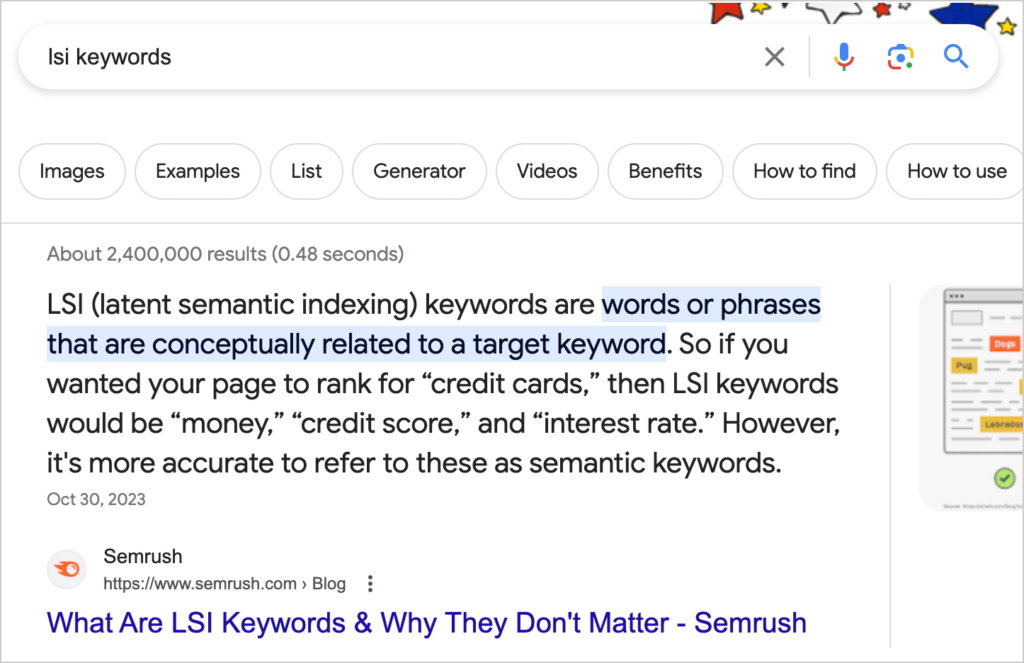
While you shouldn’t immediately dismiss an SEO professional for mentioning related keywords (which are legitimately useful), anyone specifically selling “LSI keyword research” as a premium service likely isn’t worth your investment.
How to Actually Use Related Keywords
Even though LSI keywords are SEO phantoms, let’s review some best practices for covering related topics and keywords:
- Don’t overdo it: Don’t stuff your content with related keywords. Use them naturally, just like any other words in your writing.
- Use related keywords in headings: Include them in your H2s and H3s to help search engines better understand your content. This should naturally happen by covering subtopics and interests.
- Write for humans, not robots: Your content should be reader-friendly. Don’t sacrifice readability and engagement for SEO.
- Mix it up: Use various keywords instead of repeating the same ones. This will help make your content more natural and comprehensive.
- Focus on search intent: Cover the questions and subtopics your audience actually cares about. Use tools like Google’s “People Also Ask” section and related searches to identify what users want to know about your topic.
What You Should Focus On Instead
Forget about LSI keywords entirely. Modern SEO success comes from:
- Topical authority: Creating comprehensive content that covers a subject thoroughly
- Search intent: Matching your content to what users actually want to find
- Natural language: Writing in a way that genuinely helps readers, not search engine bots
- E-E-A-T signals: Demonstrating expertise, experience, authoritativeness, and trustworthiness
Some SEO tools might still suggest LSI keywords, but treat these simply as related topic ideas rather than a ranking factor. The goal isn’t to check boxes on a keyword list: it’s to create content that fully addresses your audience’s needs and questions.